
Mikov Knife Honing Steels
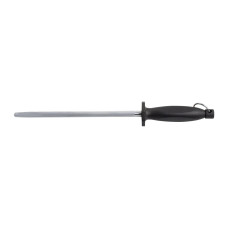
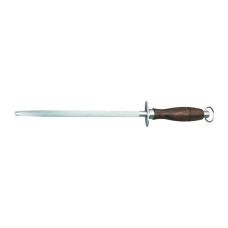
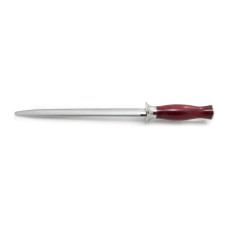
This section holds three Mikov honing steels built on the same base: a 250 mm working rod in 19421 steel with a hard chrome coating. They differ in cross-section, hardness and handle, so it is easy to match one to the knife series you use.
Comparing the models
| Model | Rod section | Hardness | Handle | Overall length | Weight |
|---|---|---|---|---|---|
| CLASSIC 896-OCR-25 | round, 12 mm | 56–58 HRc | plastic, hanging ring | 400 mm | 320 g |
| RUBY 898-OD-25 | oval 20 × 10 mm, fine cut | 62–65 HRc | wood with front and rear metal ferrules | 378 mm | 452 g |
| LUX PROFI 899-OD-25 | oval | 56–58 HRc | rosewood, ring | 390 mm | 335 g |
A honing rod should be no softer than the blade. Kitchen and butcher knives from Mikov range from 52 to 58 HRc, so all three steels suit them, and the RUBY at 62–65 HRc has the most headroom. An oval section gives a wider contact area with the edge than a round one.
How to hone a knife
- Stand the steel upright with its tip resting on a board or towel.
- Place the heel of the blade against the top of the rod at roughly 15–20°.
- With light pressure, draw the knife down so the whole edge passes along the rod to the tip.
- Repeat on the other side; 4–6 strokes per side is usually enough.
- Wipe the blade to remove metal dust.
If the knife still will not cut after honing, the edge needs sharpening on a stone: a steel only straightens it. Wash and dry the steel after use; as the product pages note, keep it out of the dishwasher.
Honing steels also come in kits: the RUBY with slicing and santoku knives, the CLASSIC in the large butcher promotional set, and there is one more in the LUX PROFI 69-5 block. Find them among Mikov knife sets, and pick knives to go with them from our kitchen and butcher knives.